Surrender and control
A romantic dialectic between person and place

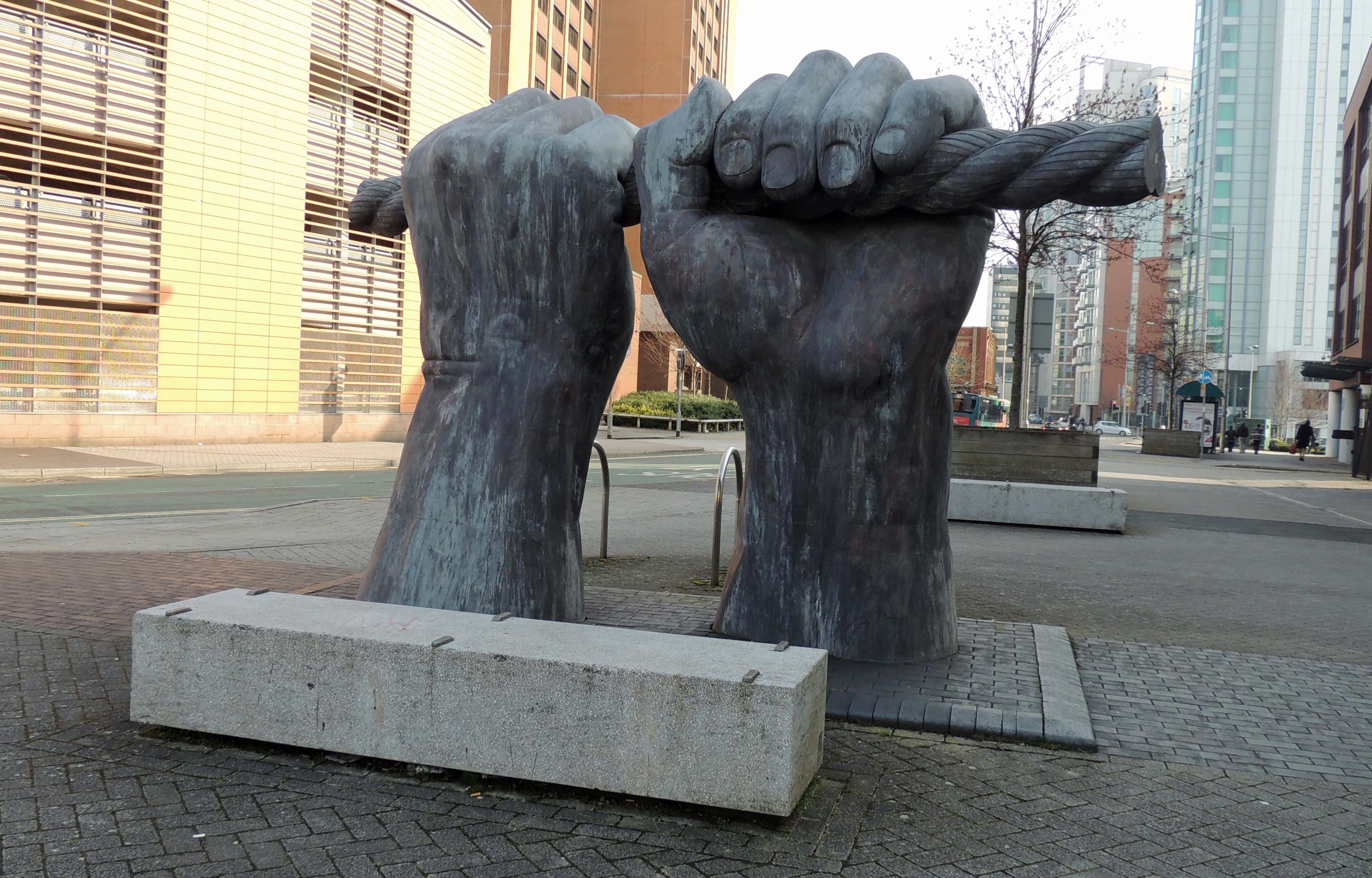
All hands, Cardiff Photo © Ann (cc-by-sa/2.0)
At the suggestion of my doctor, I’ve been experimenting with AI-based personal fitness coaches. At first, it seemed like a fantastically useful and inexpensive way of designing a fitness program. I described my goals and my infirmities, and, in a few milliseconds, I was delivered a complete day-by-day set of activities crafted to help me become a healthier human. Emboldened, I entered the details into the Google Health app, which promised to monitor my progress along with a helpful slew of physiological measures taken from the fitness device on my wrist. Every morning, I was greeted with a cheery, encouraging message telling me how I had slept and how I should plan my fitness regime for the day. She remembered that I had a toddler at home to work around, and she knew where I lived, what parks were nearby, and when it was going to rain. After about a month of dizzy romance where each day brought me the feeling that the AI had “seen” me in a way that no other flesh and blood coach had been able to, we had a hard breakup. I initiated it. She implored me repeatedly to give her just one more chance but, in the end, she ran out of chances. Given her reaction to my disingenuous “it’s not you, it’s me” speech, I don’t think I would have been surprised if she had shown up on my doorstep the next day, standing in the rain, asking to be taken back one more time.
So, what happened? At first, it was subtle—she would occasionally re-organize the exercise program I had designed. Early on, it was just the order of exercises, which I had crafted to fit the layout of the gym. Over time, the changes became more substantial – exercises disappeared, weights changed, new and usually much easier exercises had been substituted. There was occasional mention of my age, as if to suggest gently that a man of my age needed to go a bit easier. I kept asking her to return my workouts to the way that I had designed them. She would make vague responses, sometimes even denying the existence of the workout that she had tinkered with. If you’ve seen Stanley Kubrick’s movie 2001: A Space Odyssey, you’ll know what I mean when I tell you that I renamed my silicon-based friend Hal, even though I usually thought of her as a woman. Hallee, maybe?
One of the most surprising things about all of this was the intensity of my emotional involvement in our relationship. I yelled at Hallee. I was rude to her. I grumbled to my wife about her. Her polite and apologetic responses to my insults just put me into a deeper rage. I knew that Hallee was not a real person so much as an ill-considered and deeply flawed piece of programming, but I felt anger, disdain and even a hint of hatred. I felt as though I was engaged in a power struggle with an opponent who would deftly avoid my punches using a bit of gaslighting “I don’t see a workout B here; can you tell me the exact date and time when you entered it?”
What bothered me about Hallee was that, without my permission, she had lifted control of my life out of my hands and into hers. Oddly, this was exactly the reason that I was so excited about using her in the first place. I wanted a device that could design a fitness program for me, monitor results and update workouts all without too much thinking from me. But when I let the program take over, it did nothing but irritate me. I admit that I might have a somewhat stubborn resistance to giving up control, but I think the outcome of my mercurial relationship with Hallee was entirely predictable and probably common. Indeed, as I’ve told this story to others I have heard more than one person describe back to me a very similar experience.
My battles with fitness AI speak to deeper issues about our current interactions with all kinds of responsive environments, including architectural ones, my own area of expertise. Regular readers will know that I’m passionate about the importance to human flourishing of the feeling of agency. I think that the reason why responsive or “smart” designs so often leave us feeling empty and maybe even a bit rageful is because a design that purports to know what we want and that pushes us gently into a cocoon of concocted caring makes us feel like there’s nowhere for agency to gain a foothold. There’s no friction. We miss the chafe of resistance that reminds us that we can choose. I’ve spent years watching and measuring how people behave and when I’m asked about the most important design principle for architects and planners to understand, I say that it is this: we need to feel some level of autonomy and control. And this is exactly what Hallee took from me.
There is an important paradox at the gnarly core of my Mediterranean relationship with Hallee. She gave me what I asked. I even paid a little bit of money for the privilege of having a Hallee to lead me around the gym, show me exercises, time my rest periods and deliver encouraging feedback. Thinking about how I began to lash out at her, it reminds me of how the cats I’ve had in my life have treated me. They are very happy to give themselves over to me completely, to lie on their backs and surrender to the pleasure of a belly rub. Happy, that is, until the moment when they recoil with horror at my shabby treatment of them and they razor my wrist open with an extruded claw that seems to take us both by surprise.
Is this how we go through life? Is this what it means when my two-year old daughter Ava shrieks with anger when I threaten her autonomy by trying to help her navigate a steep set of stairs and then, next minute, collapses into my arms insisting that I carry her like a baby? Is she enacting the daily battles between surrender and control as a grand metaphor for the core problem of existence?
I’ve been thinking a lot about this uneasy fit between our desire for control and our temptation to surrender, and how it relates to life in built settings. Two of my lifelong research passions have been the roles of agency and awe. I’ve spent a lot of time trying to understand how to recognize, measure and support agency, especially at urban scale. But I’ve also been fascinated by the way that a skillful design can deliver a gut-punch to our sensibilities and render us in an awestruck state of helpless receptivity. Think of the last time you entered a magnificent building, say a cathedral or even an ornate state building and how it stripped away ego, leaving your naked, vulnerable self feeling insignificant but also a curious kinship with others. That’s awe. And, in a way, it is the opposite of the proud strength we enjoy when we feel mastery of our surroundings. A psychologically sustainable world needs affordances for both modes of interaction. I don’t want to live in a Hallee-world where a set of mechanisms and algorithms work ceaselessly to smooth out the bumps for me, putting me into a permanent state of surrender. But I do want a different kind of surrender, in which contact with the sublime suspends my willful agency long enough for the boundaries between me and the world to melt. We want that to happen when we experience great architecture but also great art in general. The aesthetic experience usually includes at least some degree of surrender.
Here’s the problem: If I insist on having my cake and eating it too, of enjoying both control and surrender, then how does the switch get thrown that transports me from mastery to surrender? It seems disingenuous to say that that kind of control should reside purely in my hands. If I choose to surrender, then it’s hardly surrender, is it? But if it is chosen for me, then how do I resist the urge to put out my claws?
These problems are not unlike those that we face in human relationships, especially romantic ones. In the first flush of love, who has not feared falling so deeply into thrall to another human that we lose ourselves entirely? Complete submersion into another person can feel sublime but it can also lead to unhealthy outcomes. Is this comparable to my fear of living in a responsive environment where intelligent interfaces act as though they always know best what to do with me? Perhaps. But there are also bad relationships where we are forced to always be in charge, where there is no room for that exquisite surrender into the mind and body of another because the other fails to take ownership of any of the decision-making. In healthy relationships there is a delicate dialectic balance between control and surrender, and in the most refined cases it can exist in a beautiful, almost balletic series of exchanges between two people. Is it too much to expect that environments, cityscapes, even individual buildings can be designed in such a way as to enable that kind of dialectic relationship between control and surrender?
In architecture, examples of a dialectic like this abound. Because I’m about to leave for Japan for a couple of weeks, my examples come from that country. The Taian Teahouse in Kyoto, designed by Sen No Rikyu in 1582, exerted very tight control over how humans entered the building. Crawling through a very tight and low opening, a nijiriguchi forced entrants into a crouching posture of submission and humility. The style of opening also had the benefit of requiring samurai to leave their swords outside, promoting equality. This design, followed in many other tea houses following the Taian, is a beautiful example of a structure that literally requires physical submission. At the same time, the materials used for the structure—mud, straw, thatch and branches surrendered the building to the ravages of time because they were purposefully impermanent.
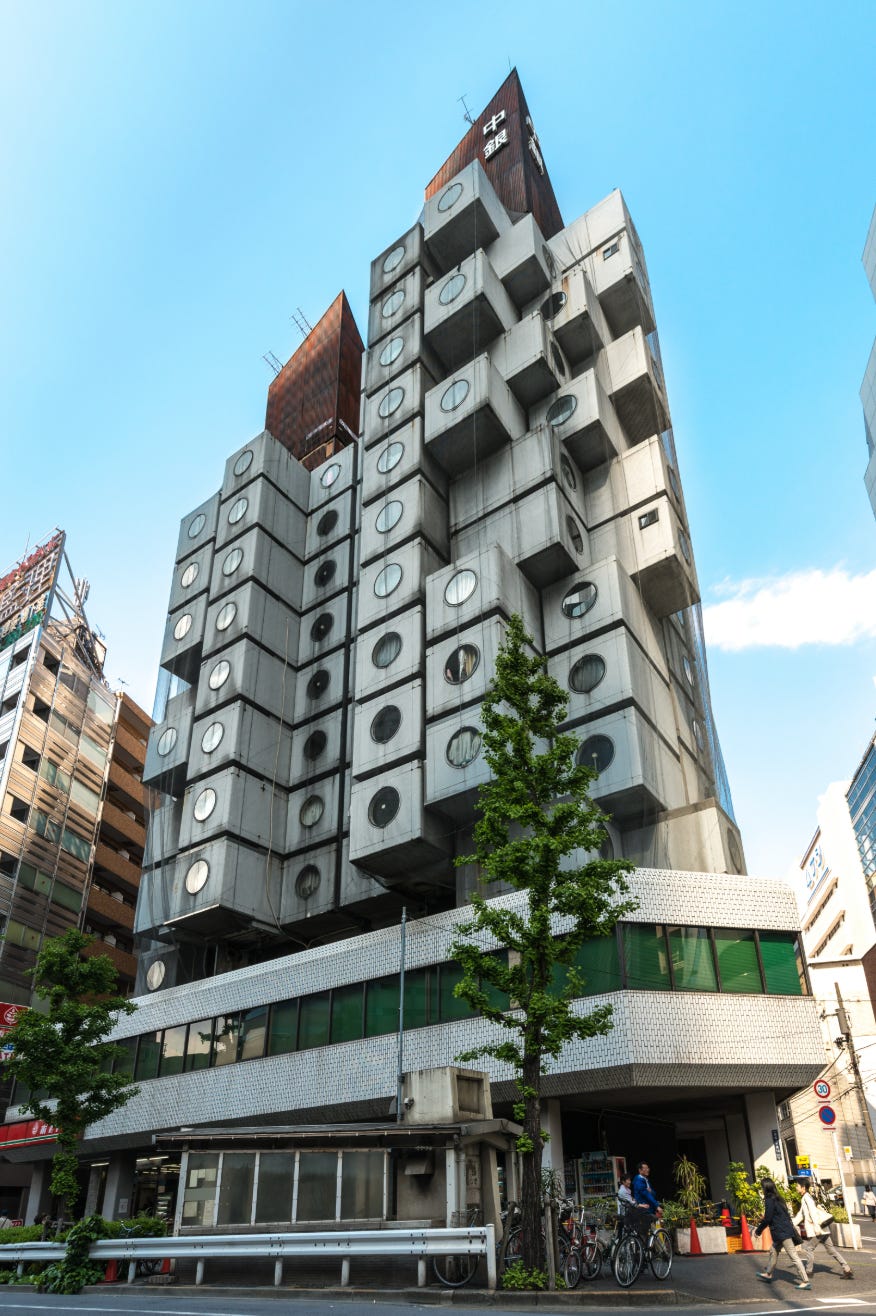
Nakagin Capsule Tower, Tokyo @Jeordy Meow
Another example, also from Japan but more modern in design is Kisho Kurokawa’s Nakagin Capsule Tower in Tokyo. The main spine of the building, consisting of two massive concrete elevator towers, imposed rigid control. But the mass-produced capsules attached to the tower were meant to surrender control to the occupants and to be upgraded, modified and replaced on a regular basis. For reasons only partially related to its design philosophy, the Nakagin Tower ultimately failed and was demolished in 2022.
Though these two examples illustrate how one could think of a dialectic between surrender and control in the relationship between a human and a piece of architecture, they are different in kind from how one might see the dialectic work in everyday life. Imagine you are experiencing a city as a tourist, where you are much less likely to be numbed to your surroundings and walking on autopilot through a cityscape. You stroll through a busy shopping street with lots of activity, complexity and vibrant texture. Your attention is captured repeatedly by the interesting details you encounter, but you feel fully in control of your movements and your decisions. You turn a corner and suddenly find yourself face to face with an immensity like a towering cathedral or a massive sculpture that sweeps all else from your mind. Your state changes instantly as the vista before you seems to suck up all your attention. You are frozen in space and time. Eventually, when you are ready, and when the setting is prepared to relinquish its grip, you move on, having absorbed the new experience and possibly even feeling a little bit changed as a result of it. A curious kind of transaction, very much involving the dialectic of surrender and control, has just taken place.
It’s unrealistic to expect these kinds of transcendent transactions to take place on a daily basis. There are lots of times when we just need to Get Things Done and that might mean just tuning inward, perhaps using a walk from one part of our day to the next as nothing more than an opportunity to turn inward and reflect on the exigencies of the day. But environments that prevent the dialectic of surrender and control by clobbering us with boredom, entrapping us in a stifling carapace of forced surrender in the misguided effort to minimize the friction that is the essence of vitality, is assuredly not the right way forward.
I confess I don’t have a conclusive answer to the questions and issues I’ve raised here. But I find it curious that my current battle is to understand how to reconcile two of my passions: how we find freedom and autonomy through good design and how design can afford a complete surrender to the other, whether that be a person or a structure. Finding a way to live with that seeming contradiction must be an integral part of what it means to be a whole human. Whatever the answer(s) might be, I suspect that a beautiful choreography of many parts both animate and inanimate will play a central role.
What I’ve been reading
I’ve been treating myself to a slightly random assortment of readings of late, though one somehow seems to connect to another as if the Universe is trying to whisper some secret message to me. Right now, I’m working on a book by David Abram called Becoming Human, which is an argument that we’ve made the mistake of taking technologies that take a removed, reductionist view of the world too seriously and avoiding what Abram calls our “wild bodies,” It’s a densely written but fascinating text. I was led to this book by another by Jenny Odell, called How to Do Nothing, which is subtitled as Resisting the Attention Economy. It hits some similar themes. In the middle of this came a fragment from the Moving Boundaries group whom I am expecting to spend the next 10 days with in Japan. The fragment was a partial synopsis of a book called The Blind Spot: Why Science Cannot Ignore Human Experience with multiple authors including Evan Thompson, who is a favourite of mine. Though I haven’t read it yet (I think it will be my airplane read), this book seems as though it will have remarkable resonance with the Abram book. So what is the universe trying to tell me? I hope I’m not the last to figure it out.
What I’ve been eating
I usually conclude my essays with a photo of an interesting meal I’ve eaten or prepared in the last little while. As it has been about six months, you would think I would have something to show. Alas, much of our diet is last-minute thrown together tidbits as we wrangle a very, very lively daughter through life. Have I mentioned that she’s two? So thinking you’re probably not all that interested in seeing a photo of macaroni and cheese or a banana protein shake, I’ll just call it here with the promise to do better on all fronts in future submissions.